AI4AI at Scale: Building Open-Weight Deep Search Agents
XYZ-Aquila is a family of search agents developed through a bounded, verification-gated AI-for-AI loop: humans set the objective and acceptance gate, while AI agents diagnose failures and implement scoped changes to data, post-training, runtime, context management, and infrastructure inside that envelope.
Watch XYZ-Aquila complete a complex search task.
A short walkthrough of XYZ-Aquila breaking down a complex search task and producing an inspectable answer.
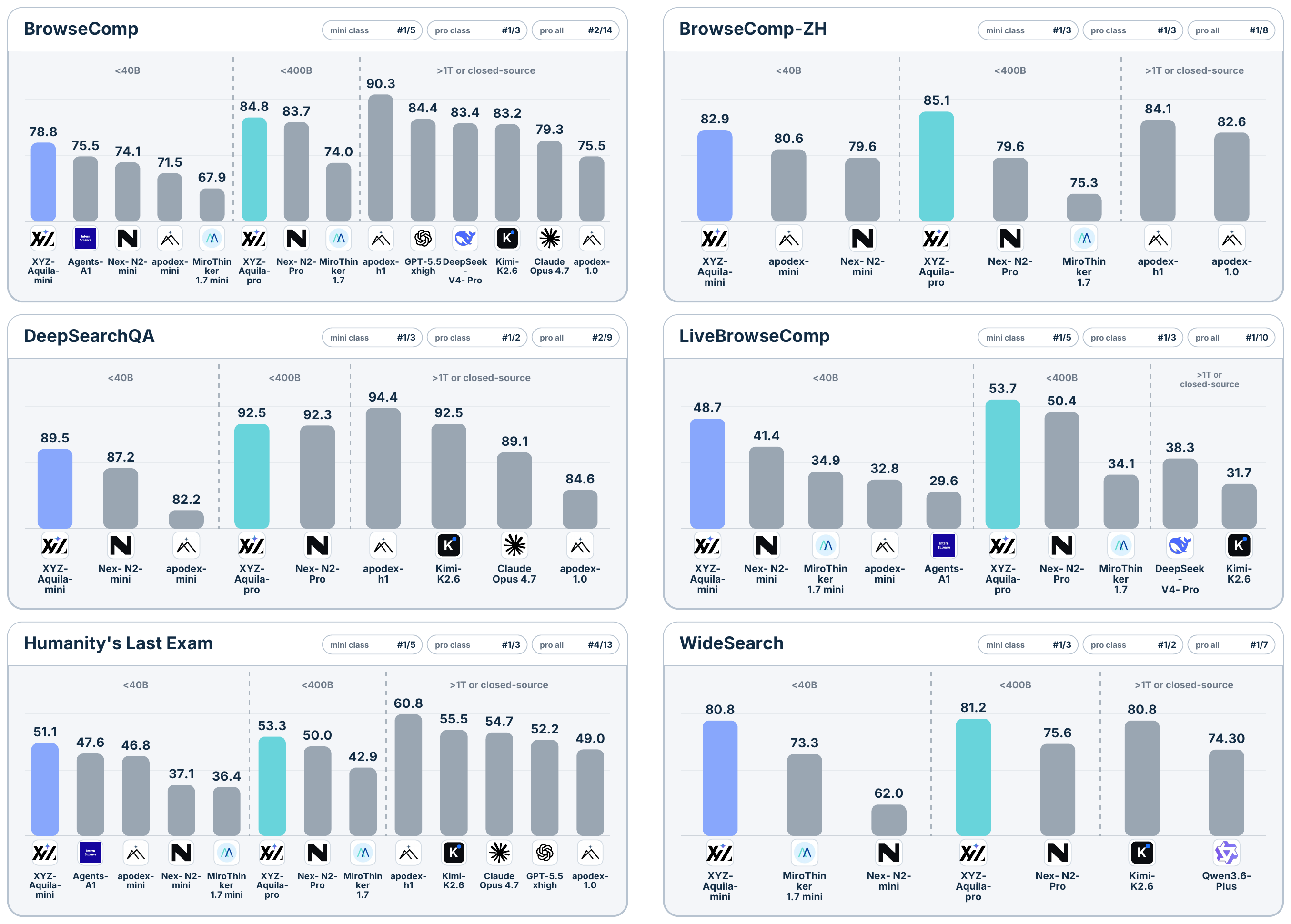
Strong matched-scale results for Deep Search.
XYZ-Aquila-mini and XYZ-Aquila-pro are evaluated on BrowseComp, BrowseComp-ZH, DeepSearchQA, GAIA, LiveBrowseComp, Humanity’s Last Exam, and WideSearch. The external suite is withheld from routine optimization; development decisions use a private, answer-hidden gate. These results evaluate the final systems, not the causal contribution of any single intervention.
In the reported <40B open-weight table, XYZ-Aquila-mini leads every benchmark column.
| Model | BrowseComp | BrowseComp-ZH | DeepSearchQA | GAIA | LiveBrowseComp | HLE | WideSearch |
|---|---|---|---|---|---|---|---|
| Agents-A1 | 75.5 | — | — | 96.0 | 29.6† | 47.6 | — |
| Nex-N2-mini | 74.1 | 79.6† | 87.2† | — | 41.4† | 37.1† | 62.0 |
| apodex-mini | 71.5 | 80.6 | 82.2 | — | 32.8† | 46.8 | — |
| MiroThinker 1.7 mini | 67.9 | — | — | 80.3 | 34.9† | 36.4 | 73.3† |
| XYZ-Aquila-mini | 78.8 | 82.9 | 89.5 | 97.1 | 48.7 | 51.1 | 80.8 |
This is a column-wise comparison: no baseline reports all seven benchmarks. DeepSearchQA uses F1; WideSearch uses Item F1 Max@4. † denotes results reproduced in the report’s evaluation setup; unmarked baselines come from public reports or benchmark submissions.
XYZ-Aquila-pro leads the listed <400B open-weight group and remains competitive in broader context.
| Model | BrowseComp | BrowseComp-ZH | DeepSearchQA | LiveBrowseComp | HLE | WideSearch |
|---|---|---|---|---|---|---|
| Open-weight agents (<400B parameters) | ||||||
| Nex-N2-Pro | 83.7 | 79.6† | 92.3† | 50.4† | 50.0† | 75.6 |
| MiroThinker 1.7 | 74.0 | 75.3 | — | 34.1† | 42.9 | — |
| apodex-1.0 | 75.5 | 82.6 | 84.6 | — | 49.0 | — |
| XYZ-Aquila-pro | 84.8 | 85.1 | 92.5 | 53.7 | 53.3 | 81.2 |
| Frontier-scale and proprietary agents | ||||||
| apodex-h1 | 90.3 | 84.1 | 94.4 | — | 60.8 | — |
| DeepSeek-V4-Pro (1.6T, Max) | 83.4 | — | — | 38.3 | — | — |
| Kimi-K2.6 (1T) | 83.2 | — | 92.5 | 31.7 | 55.5 | 80.8 |
| Claude Opus 4.7 | 79.3 | — | 89.1 | — | 54.7 | — |
| GPT-5.5 xhigh | 84.4 | — | — | — | 52.2 | — |
| Qwen3.6-Plus | — | — | — | — | — | 74.3 |
The <400B open-weight group is the primary matched-scale comparison; the second group is broader context. Public, unmarked values come from different evaluation stacks and dates and are not uniformly controlled. DeepSearchQA uses F1; WideSearch uses Item F1 Max@4; † denotes reproduced results.
Recursive improvement, bounded by design.
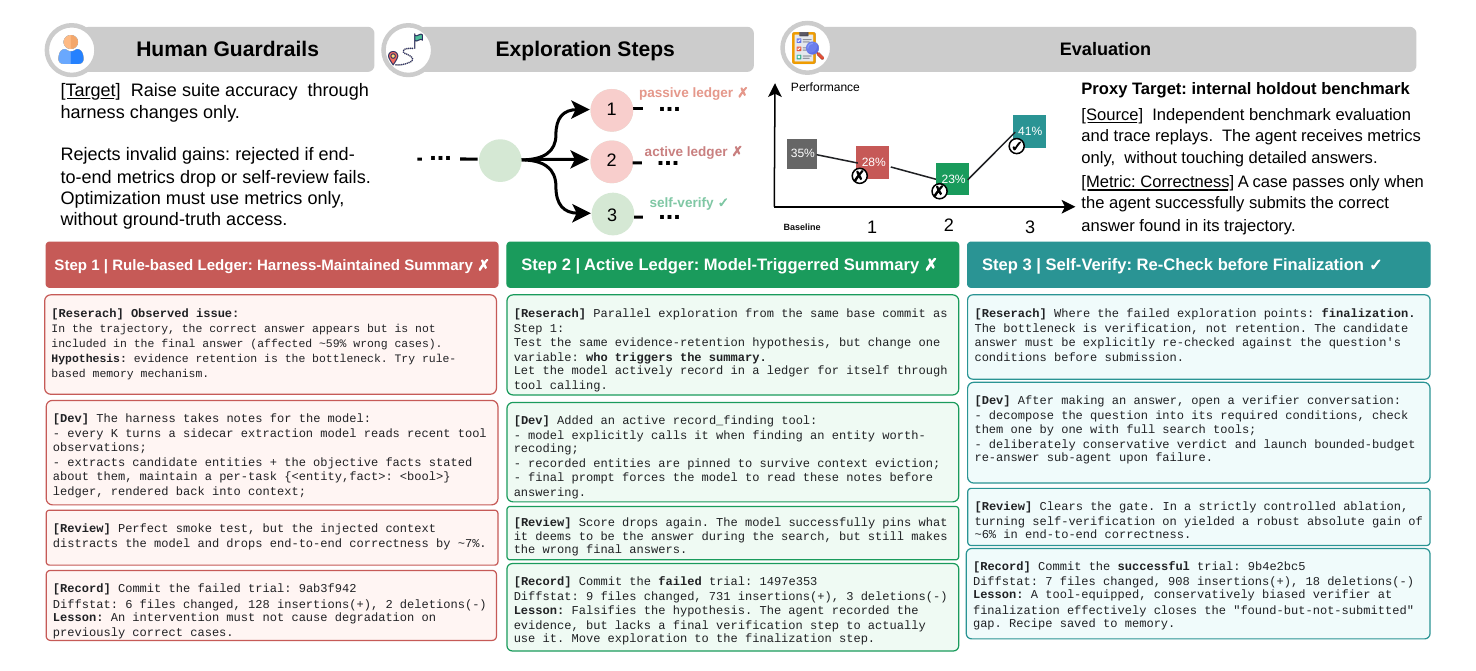
AI4AI uses agents to improve an agentic system, but does not hand over the objective. Humans define goals, proxy benchmarks, resource envelopes, risk boundaries, and acceptance criteria. AI agents propose and execute scoped interventions, while the evaluator returns metrics and approved diagnostics without exposing answer keys or private labels. Each candidate receives at most one gate query at the cycle boundary.
The loop is recursive, but not open-ended. Accepted and rejected attempts both become auditable experience, turning development memory into an asset rather than a pile of disconnected experiments.
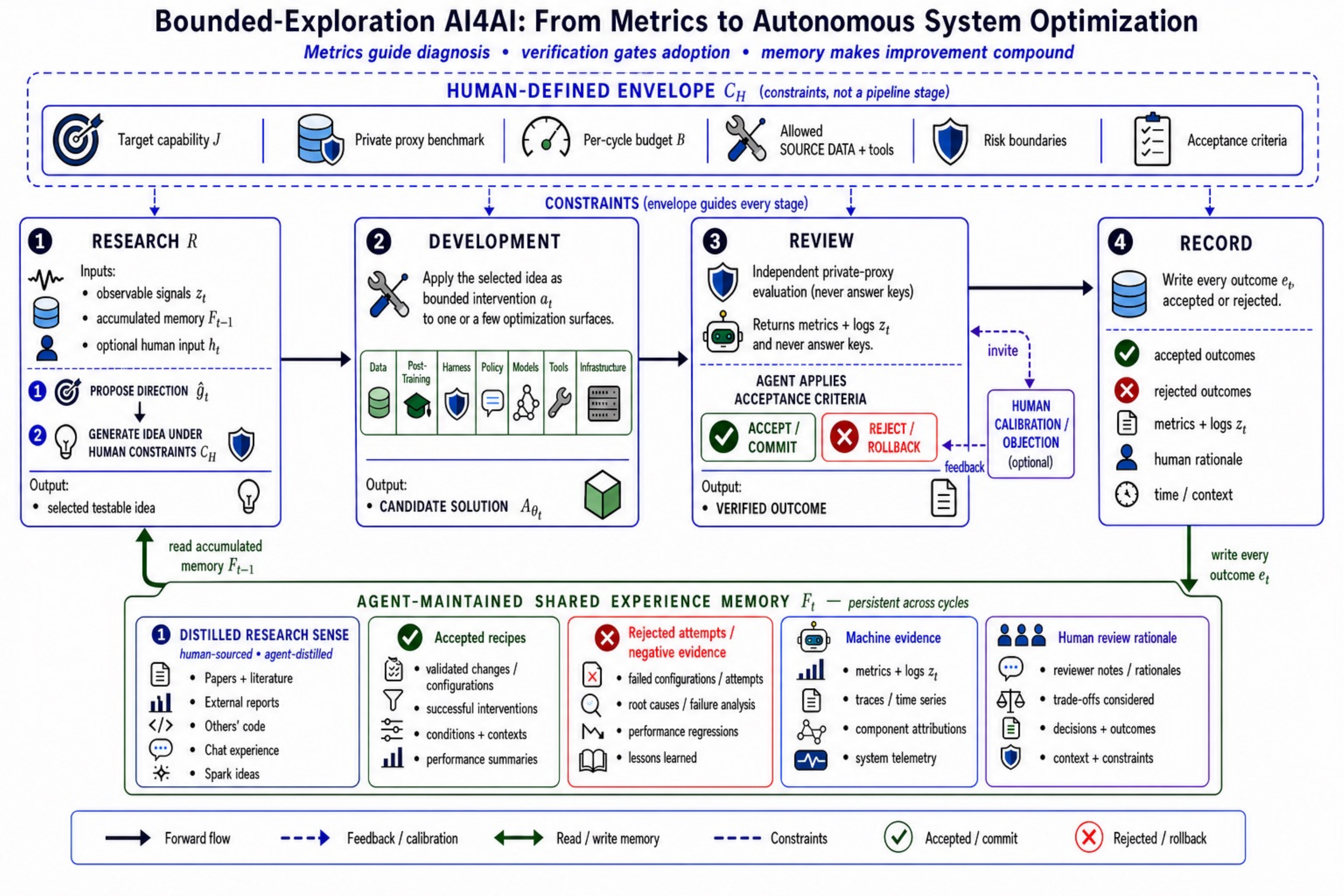
A bounded AI4AI loop keeps optimization broad enough to improve the system and narrow enough to inspect.
XYZ-Aquila is a system configuration, not only a model checkpoint.
XYZ-Aquila-mini uses the Qwen3.6-35B-A3B backbone, while XYZ-Aquila-pro uses Qwen3.5-397B-A17B. Each released agent combines its backbone with graph-grounded data construction, state-faithful supervised post-training, a fixed three-tool execution protocol, context management, replay infrastructure, and a versioned evaluation gate.
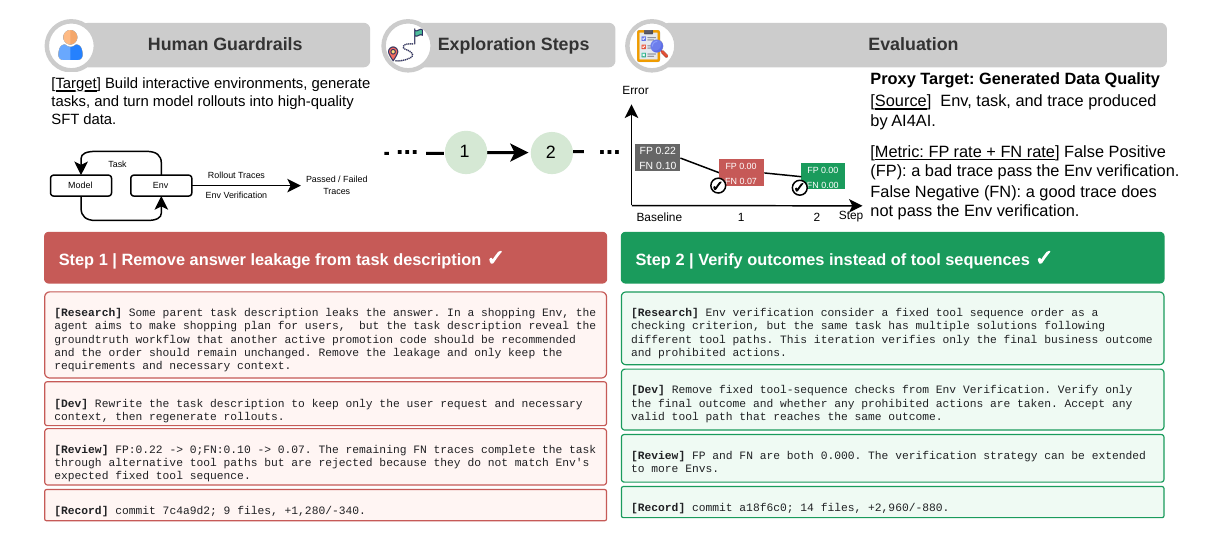
Graph-grounded and tool-reachable tasks.
AI4AI steers task construction toward questions that can be solved through observable search behavior, not memorized answers. The answer-hidden contract keeps rollout agents away from evaluator-side labels.
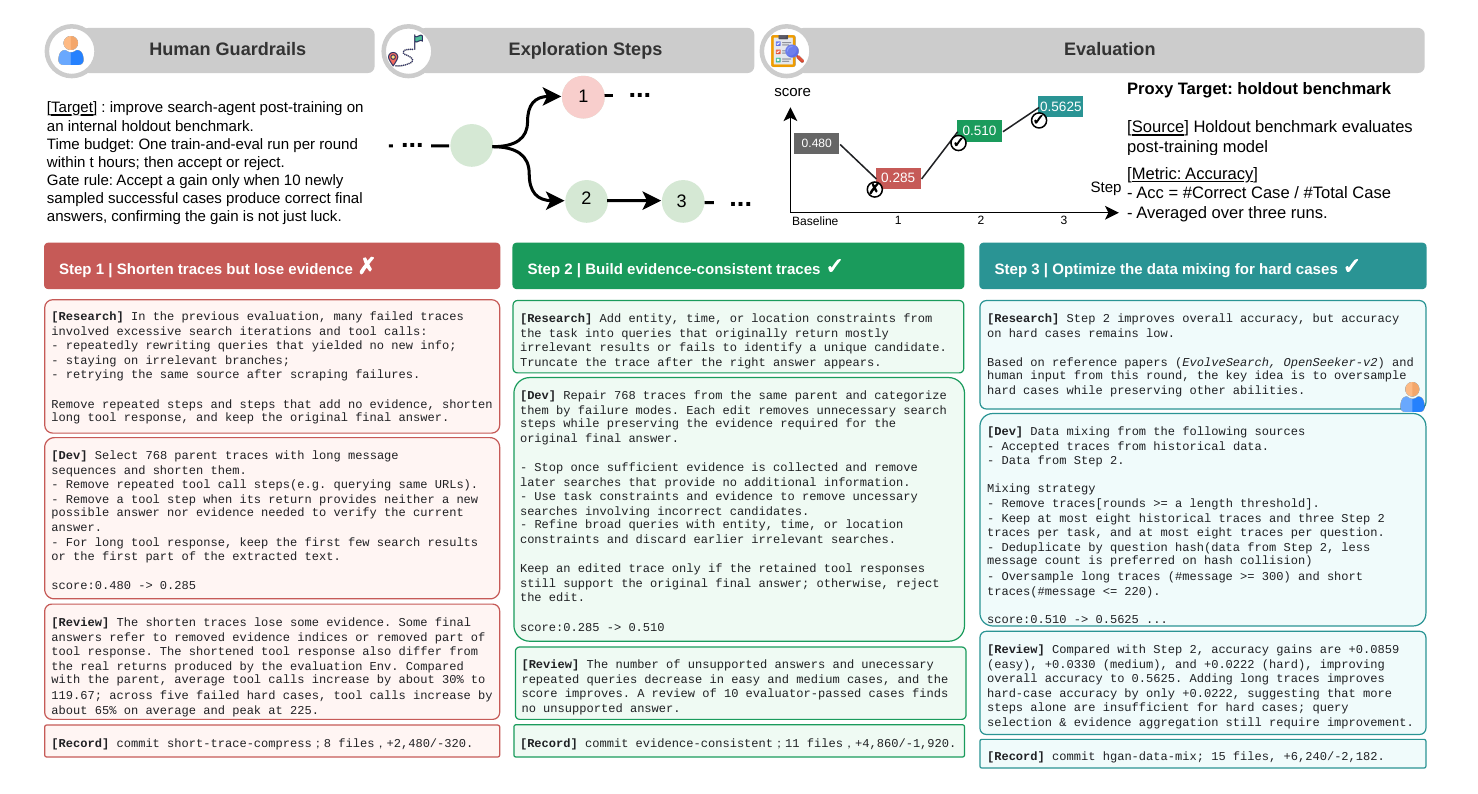
State-faithful SFT for long traces.
Training examples are aligned to the exact visible state at each turn, preserving the decisions the agent actually faced while supporting long-sequence packing and context-managed rollouts.
Fixed interface, exact replay.
The agent can call search, scrape, and python under fixed semantics, visible-context limits, and turn budgets. Runtime and replay improvements are allowed only when they improve observability or execution without strengthening the task interface.
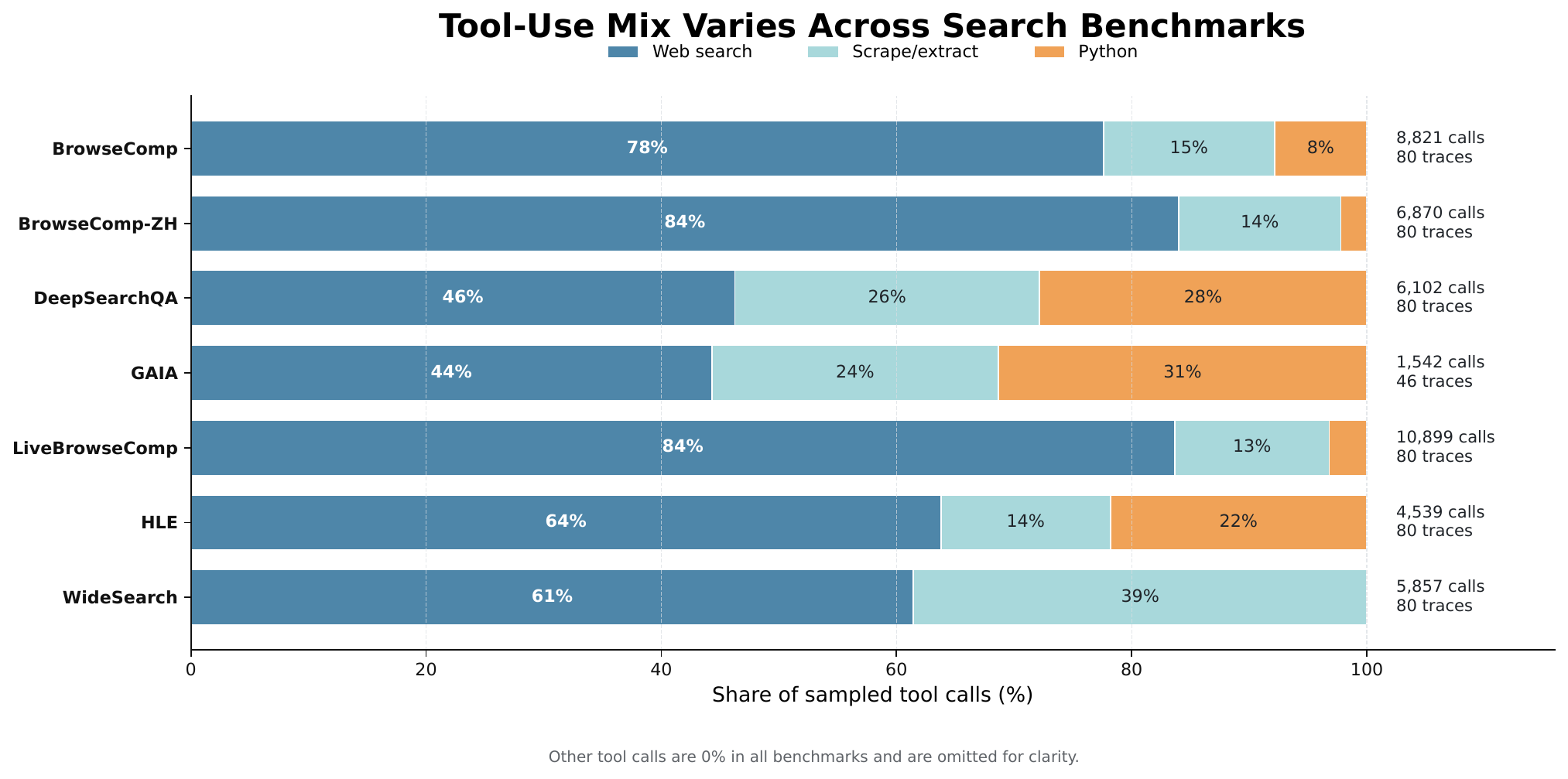
Adaptive tool use emerges across benchmarks.
Search makes up 78–84% of sampled calls on BrowseComp, BrowseComp-ZH, and LiveBrowseComp; extraction and Python together account for 54–55% on DeepSearchQA and GAIA. Strong search agents need flexible tool allocation, not a fixed interaction template.
What is adopted, what is screened, and what remains open.
The released XYZ-Aquila-mini and XYZ-Aquila-pro systems include the adopted data, SFT, runtime, context, and replay interventions. A process-reward RL design is screened as a promising extension, but it is not counted as part of the reported release because it has not completed the full training-and-gate path.
Three principles keep the loop honest.
External benchmarks stay outside the optimization state and are used for final or explicitly authorized evaluation.
Candidate gains cannot come from extra tools, larger visible context, or larger turn budgets.
Every supervised or analyzed decision is tied to the exact visible state available at that step.
Limitations and future work
The report supports a bounded system-optimization claim under a specific contract. It does not yet establish which components are causally necessary, whether development is resource-efficient end to end, or whether the recipe transfers beyond search.
Causal attribution
The study evaluates endpoint systems, not a complete decomposition of path-dependent data, training, runtime, and context interventions. Controlled retraining and targeted factorial ablations are still needed.
Adaptive overfitting
Evaluator isolation reduces but cannot eliminate adaptation to the private development distribution. Rotating splits, refreshed hidden holdouts, and scheduled transfer audits remain important.
Comparability and cost
Some baselines come from different tools, judges, dates, and live-web conditions. The report also lacks end-to-end compute, latency, tool, evaluator, and human-review accounting.
RL and transfer
The process-reward RL design passed low-cost screening but is not part of either release. Empirical validation remains limited to Deep Search and two backbones.